I have always admired Beverly Naya’s acting skill. As a talented Nollywood actress and a cultural voice, her decision to produce the documentary Skin initially felt like a step toward a much-needed conversation about colorism. But admiration shouldn’t blind us to intellectual laziness, especially when it is packaged as activism.
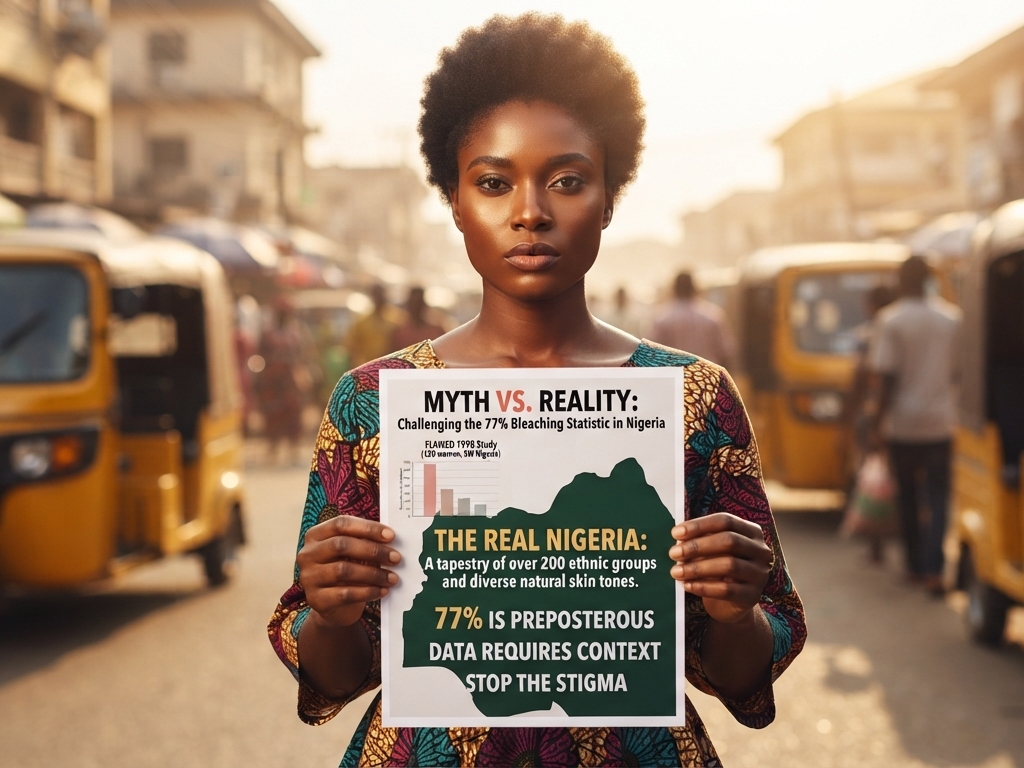
My frustration peaked when I heard Naya repeat a claim that has always struck me as utterly preposterous: that 77% of Nigerian women bleach their skin. Let that number sink in for a moment.
Seven out of every ten women you pass on the bustling streets of Lagos, Abuja, or Enugu are, according to this statistic, actively altering their complexion. Where did this mythical 77% come from?
Like many urban legends that morph into “facts” through endless repetition, it traces back to a localized 1998 study of just 450 traders in a single market in the South-West of Nigeria, a region where women are predominantly darker-skinned compared to other parts of the country.
Even within the South-West, nuance is missing: women from the Ondo and Ekiti axis are predominantly lighter than other South-Western women.
Beyond that, look at the broader geographic mosaic of our nation. Other parts of Nigeria, like the South-East, feature populations that are naturally lighter-skinned. Then you look to the North —especially the Fulani— where women are majorly lighter-skinned, with some carrying mixed heritages due to nomadic lifestyles that historically intertwined with North African populations.
This brings us to a fundamental question: Is Beverly saying that all Africans are dark-skinned? Are all Nigerian women dark-skinned? Do they all come from the same ancestors or roots?
Nigeria is a conglomerate of different nations coupled together by the British, housing over 200 distinct tribes. For someone who claims to be educated, relying on a localized regional sample to cast a blanket judgment over a diverse nation of distinct ethnic realities is an uneducated perspective. A snapshot of a specific demographic at a specific time was weaponized, generalized, and parroted by global networks and local public figures alike, transforming a flawed sample into a national indictment.
The Economics of Compliance and the Male Gaze
This feels less like a genuine quest for truth and more like a personal vendetta born from a deep-seated inferiority complex. There is no denying that real prejudice exists against dark-skinned women. We see it in how casting directors in films, music videos, and even HR departments in organizations often prefer to use lighter-skinned women for jobs and roles.
“Lighter-skinned women are not darker-skinned women’s problems! There’s a divide carefully orchestrated to tear down most women’s value of themselves in order to please men.”
But we must also talk about the double-edged sword. Most of the lighter-skinned women employed in these corporate spaces are frequently used as tools by gatekeepers to lure and attract male clients and customers. In many banks, these women are victims disguised as beneficiaries, shoved into “marketing” positions where they are treated as sex symbols or toys. They are often told, “You don’t have to do anything, you are a fine lady, you know how men are, so just smile and the contract will come to you.”
At its core, this is a global game tied directly to economic power. Whoever holds economic power dictates the market and controls the economy.
For centuries, men wielded absolute economic power, inadvertently dictating what women had to do to acquire financial autonomy. In the past, when women could not own properties, vote, or build independent legacies, survival dictated financial dependence on men. He who pays the piper dictates the tune. If the corporate client or economic overlord preferred lighter-skinned women, the market adjusted accordingly, a textbook application of demand and supply.
The true underlying issue is about financial sovereignty. If I do not have to please anyone or rely on anyone for my sustenance, external preferences lose all power over my choices. Thankfully, this dynamic is shifting as more women choose themselves and build independent wealth.
Women are still held up to ridiculous standards purely to be pleasing to men. I recall a male friend I met on a show who became a frequent collaborator. When it came to sending a proposal to Abuja for major funding on an innovative project, the team of men unanimously nominated me to go do the presentation, hiding behind the stereotypical excuse that “beauty attracts the man.” I looked the project leader, a man who claimed to be in love with me, straight in the eye and asked, “So if the man tells me to have an affair with him, as these so-called bigwigs often do, to approve this project that is very dear to you, what do I do? Because I definitely won’t agree to that.” Instead of answering, he evaded the question: “It won’t come to that,” and “You are smart, so you will outsmart him.”
My question was about responsibility. Where would the blame fall if the project wasn’t approved? Would I be branded as a failure for refusing to use my “feminine wiles”? This dynamic is precisely why I consciously altered my voice tone from its natural flow, because men constantly derailed and detoured from serious conversations by straying into talks about sexual relationships because my voice was ‘sexy’. It’s why I avoid picking up calls right after waking up, and why I learned to deflect predatory advances with jokes rather than directly telling men off. I recall Tems in an interview talking about how she dressed to studios in ‘baggy’ outfits just so the men she interacted with could focus on her talent.
The Real Roots of Skincare Choices in Nigeria
Beverly’s veiled attack is deeply misplaced. Pitting darker-skinned women against lighter-skinned women creates an artificial divide. Whether it’s skin tone, age, marriage, career, voice, mannerisms, or body structure, society targets women’s self-worth to please the male gaze. If this documentary were about telling the truth, actual research would have been prioritized. Instead, it feels like someone cherry-picking data to validate an erroneous bias.
Global Context: Do Asian women want to be whiter? Why do Western and European women bathe in milk (which contains lactic acid)?
The Sun and Climate: The harsh Nigerian sun is enough to make anyone look darker than their natural skin tone. Is it a crime to look for skincare that brightens and protects the skin?
The Source and the NAFDAC Failure: We must ask where the bulk of these harsh bleaching products actually come from. Many are mass-produced and heavily imported from overseas markets in Asia, Europe, and neighboring West African countries. Most cheap, chemical-laden options are toxic, fake versions flooding the market because affordable, authentic skincare formulated safely for African skin is notoriously difficult to find. Many naturally fairer women buy these products simply to maintain their skin against harsh conditions. This is why I personally transitioned to African black soap, shea butter, and proper dieting. Protecting citizens from toxic imports is the fundamental job of NAFDAC, rather than blaming everyday women for navigating a compromised market.
Seeing herself, or any talented, beautiful dark-skinned woman, not placed on a pedestal can be psychologically draining and depressing. But projecting that internal frustration into an indicting, unverified documentary hurts the entire sisterhood.
A Call for Responsible Storytelling
Women need to be extra careful when putting out narratives centered on women, because history has historically marginalized us.
From minimizing women’s contributions to lumping women and children into the same category, society has always inflicted damage on women, especially Black women who already fall to the bottom of global “beauty statistics” and economic scales.
By recycling these lazy figures, the documentary effectively casts an unfair cloud of suspicion over naturally lighter-skinned Nigerian women, forcing them to constantly defend their complexion against a default assumption of bleaching. As if women didn’t already face enough relentless scrutiny, where every square inch of a photograph is picked apart for belly fat, thinness, age, or physical flaws, complete with aggressive digital zooming to dissect wrinkles or edited shapes, this narrative adds an extra layer of hostility. It unfairly sets up fairer women for targeted attacks centered entirely on skin tone, born from a flawed and fabricated statistic.
So it forces the critical question: What does this documentary actually solve? What meaningful issue does it highlight? Are lighter-skinned women being penalized simply for the shade of their skin, and why must a woman be the one to push this divisive narrative further? Was this thoroughly done out of concern? Is this proof of women failing to support women?
No female filmmaker who understands the power of narratives should irresponsibly promote propaganda that fractures the very circle she belongs to. I sincerely hope Beverly looks into the uproar her documentary has caused.
When data is missing, logic fails, and a narrative relies on shaming rather than healing, we have to ask: Why this narrative?
Nigerian women deserve better than sensationalized trauma exploitation masquerading as documentaries.